
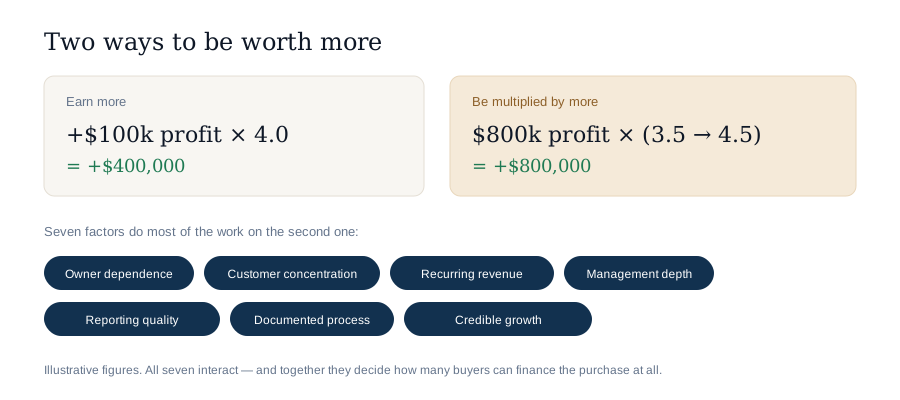
There are two ways to be worth more. Earn more, or be multiplied by more. Owners spend nearly all their energy on the first and almost none on the second, which is backwards: an extra $100,000 of profit at a 4× multiple adds $400,000, but moving from 3.5× to 4.5× on $800,000 of earnings adds $800,000 and requires no new customers at all.
Seven factors do most of the work.
1. Owner dependence
The single largest one. If the relationships, the quoting, the technical judgment and the key accounts run through you, a buyer is not acquiring a company — they are acquiring your job, with debt attached. Every task you genuinely hand off raises what the business is worth to someone who is not you.
2. Customer concentration
One customer at forty percent of revenue is one conversation away from destroying the loan the buyer just signed. Lenders price this explicitly. Deliberately diluting a dominant account over two or three years is slow, unglamorous, and among the highest-return work available.
3. Revenue predictability
Contracted, recurring or reliably repeating revenue is underwritten at a premium, because it is the part of next year a buyer can actually count on. Service agreements, maintenance contracts, renewals and standing orders all convert one-time revenue into the kind a lender will lend against.
4. Management depth
A second layer means continuity. It answers the question a buyer cannot ask politely: what happens if you are hit by a bus between the LOI and closing — or six months after it.
5. Financial reporting quality
Reviewed statements, a consistent chart of accounts, timely monthly closes. This does not change what you earned. It changes how fast and how confidently a buyer can believe it, and confidence is priced.
6. Documented process
Written procedures transfer at closing. Knowledge held in people's heads does not. A business a competent stranger could run from the documentation is worth more than an identical one that only works because the current team improvises well.
7. Credible growth a buyer can execute
Not a story about potential — every seller has one of those. Identified opportunities with evidence: a territory that works, a product line with early traction, a channel a similar business already exploits. A buyer pays for growth they can see how to capture.
The compounding part
These interact. Reducing owner dependence usually requires documented process, which requires a management layer, which makes clean reporting easier — and the combination widens the pool of buyers who can finance the purchase at all. More qualified buyers means competition, and competition, not negotiation, is what produces a strong price.
Which is why this work belongs three to five years before an exit. Not because it takes that long to do, but because it takes that long to show up in numbers a buyer will underwrite.